Affiliate links included for your convenience. Thanks to Tuttle for providing a review copy of this book to me!
Japanese minimalism has been a popular approach to decluttering and home organization around the world for decades now. Learn the basics as well as why this approach is helpful in Danshari: The Japanese Art of Decluttering Your Space to Transform Your Life by Hideko Yamashita.
Billed as “Japan’s original decluttering guru,” (yes, she was around before Marie Kondo) Yamashita is enthusiastic and encouraging, and this little book takes you through the basics of what danshari means and how to incorporate it into your life.
What is Danshari?
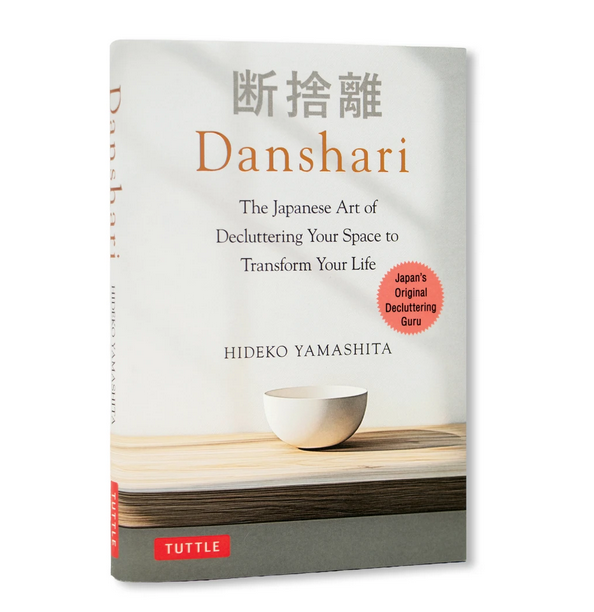
Danshari is a word the author coined (you know I love making up words!) from words that basically mean refuse, release and renew. She explains it like this:
if you “refuse” the unnecessary (dan), and “release” the clutter (sha), then you will “renew” your life (ri) by letting go of your attachment to these things.
More specifically, the idea come from yoga and the practice of dangyo, shagyo and rigyo, or cutting off, discarding and separating, which is a method of releasing attachments.
The idea is that it is more than just a decluttering and organizing process, but a method of “reviving the flow of a life weighed down by stagnation.” It works on more than just stuff, but can also open up space for changes in work, relationships and more.
How Are Your Relationships?

The way you go about decluttering in Danshari is by thinking about your present day relationship with your stuff. Maybe you have clothes that no longer fit, so you are not in relationship with those things right now, therefore they have no value to you and shouldn’t be in your home.
You might have supplies for crafts you meant to try but never did, or used to do but don’t any more.
She uses the concept of “necessary, appropriate and pleasant” as a way to evaluate your things.
Is this item necessary for the way you live your life now? Is it appropriate in terms of what you need (or how many you need)? Is it pleasant (which can mean nice to use or look at, comfortable, etc.)?
Dansahri Rules

The book also covers some rules that are helpful as a framework as you declutter. The main one is the 7-5-1 rule, which states that hidden storage like closets and drawers should be more than 70 percent full. Visible storage like glass fronted cabinets should only be 50 percent full, and display storage (surfaces that are used for decorative purposes) should be just 10 percent full.
Luckily bookshelves get to be more than 50 percent full, but there should still be some breathing room and things should be easily accessible.
Another rule is the one-step rule, which says that you should be able to get things out and put things away in one step. It’s opening the drawer and grabbing the thing, not opening the cabinet, pulling out the box, taking out the other thing. This is a hard one for crafters, but something to think about for the things you use most often.
Does Danshari Work for Crafters?

The idea behind Danshari is giving us breathing room in our spaces and in our lives. The book talks about a lot of famous comedians keep their spaces clean and uncluttered and that reflects the orderly memory that’s required to be a quick-thinking comic.
“It may sound like stretching the point, but in many ways a person’s living environment is reflected in their art,” she writes.
And I think we know that, and the times when our spaces have been clean and clear we can feel the difference in what we want to make and how we approach making. I know that’s true for me.
This is an approach that also asks you to consider the energy of things, which I’ve talked about before as being one of the hard parts about getting rid of craft supplies.
every object represents more than just itself — it embodies the time, effort and feelings that went into acquiring and keeping it. This is why, through Danshari, narrowing your possessions down to only your favorite things means that the time you spend, the effort you make, and the feelings you invest in them all become higher in quality.
And while as crafters we’ll probably always have stash, she points out that the more things connected to past us or future us that we have, the harder it is to be truly present in the moment. I know I can feel that from a crafty point of view, too, that all the supplies I have are a never-ending list of things to make, which probably does prevent me from enjoying my current make as much as I could.
The book includes case studies, tips for cleaning out particular areas and lessons from decades of Dansahri practice. It might just inspire you to clear a little corner or a drawer and move on mindfully considering your relationship to your stuff right now.
About the book: 192 pages, hardcover, published 2026 by Tuttle Publishing. Suggested retail price $16.99.